Earthy Wedding Colors with a Pop: The 2026 Update to Neutrals
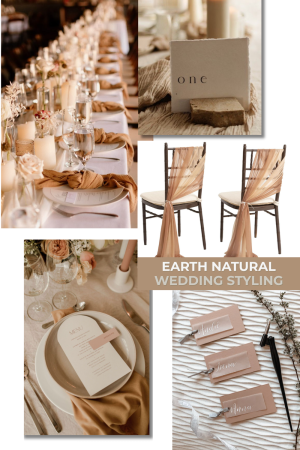
Earthy wedding colors—those grounding shades of beige, stone, and mocha—have long been the “safe harbor” of wedding design. They are timeless, easy to live with, and inherently elegant. But as we move into 2026, we’re seeing a shift in the editorial world. Couples are realizing that while a purely neutral palette is calm, it can sometimes lack a focal point. Without a bit of “visual friction,” the design can feel a little flat, almost like a beautiful room where the lights haven’t been turned on yet.
The solution isn’t to abandon your love for nature-inspired tones. It’s about intentional punctuation. By adding one single, thoughtful “pop” of color, you transform a safe palette into a memorable atmosphere.
Why Your Palette Needs “Visual Punctuation”
When everything stays within the same tonal range, the eye doesn’t know where to rest. In a sea of beige and stone, your guest’s experience can start to blend together. You might find that:
The Depth is Missing: Photos can look one-dimensional because there’s no contrast to create shadows or highlights.
The “Hero” Elements Get Lost: Your stunning floral arrangements or your intricately designed cake can disappear into the background.
Introducing a pop of color acts like a lightbulb in a dark room. It creates intent. It tells your guests exactly where the beauty is hidden.
The 2026 Pairings: How to Refresh Your Base
For 2026, the trend isn’t about “colorful weddings”—it’s about neutrals with a secret. Here are three ways to modernize your earthy base:
1. Mocha + Citrus: The Modern Energy Mocha tones are incredibly rich and grounding, but they can feel heavy in a summer wedding. Adding a soft, zesty citrus accent—think a pale clementine or a sun-bleached apricot—introduces a burst of optimism.
The Vibe: High-fashion, energetic, and warm.
The Pro-Tip: Use the citrus only in “movement” items, like thin silk ribbons or a few specific stems in the bouquet.
2. Sage (or Smoky Jade) + Butter Yellow: The “It” Couple Sage is the ultimate comfort color, but pairing it with Butter Yellow is the 2026 “glow up.” It feels like a garden at sunrise.
The Vibe: Gentle, fresh, and incredibly refined.
The Design Story: This works best when the yellow is treated as a “flicker” of light—a yellow candle, a single petal, or a delicate calligraphy ink.
3. Stone + Terracotta: The Mediterranean High-End Stone and beige feel architectural, while terracotta adds a “lived-in” warmth.
The Vibe: Earthy yet elevated; it feels like a sun-drenched terrace in Italy.
The Design Story: This is about materiality. Use terracotta in its literal form—ceramic vases or stone-textured menus—to keep it feeling organic.
The Stylist’s Secret: The “Rule of Three”
To keep the color from feeling random, I always use the Rule of Three. Don’t just place your “pop” once. Let the color “travel” through the room at different eye levels:
Low: A tinted glass tealight or a napkin.
Medium: An accent bloom in the centerpieces.
High: A detail in the hanging florals or the top of the cake. This creates a rhythm that feels like a professional designed the room, not just a decorator.
Where to Add Color Safely
Subtlety is your greatest tool. To keep the look refined, keep your large surfaces (table linens, drapes, walls) in your neutral base—like Cloud Dancer—and save the color for the details:
Florals: The most natural place for contrast.
The Cake: A neutral base with a “painterly” stroke of your accent color.
Stationery: A colored envelope or a wax seal that hints at the “pop” before the wedding even begins.
The Final Verdict: Restraint is Luxury
Earthy palettes with a pop work because they respect breathing room. To keep it from turning into “Boho Overload,” stick to one accent only, balance it with soft neutrals, and let the design exhale. When you give your color space to breathe, it doesn’t just sit in the room—it makes a statement.